
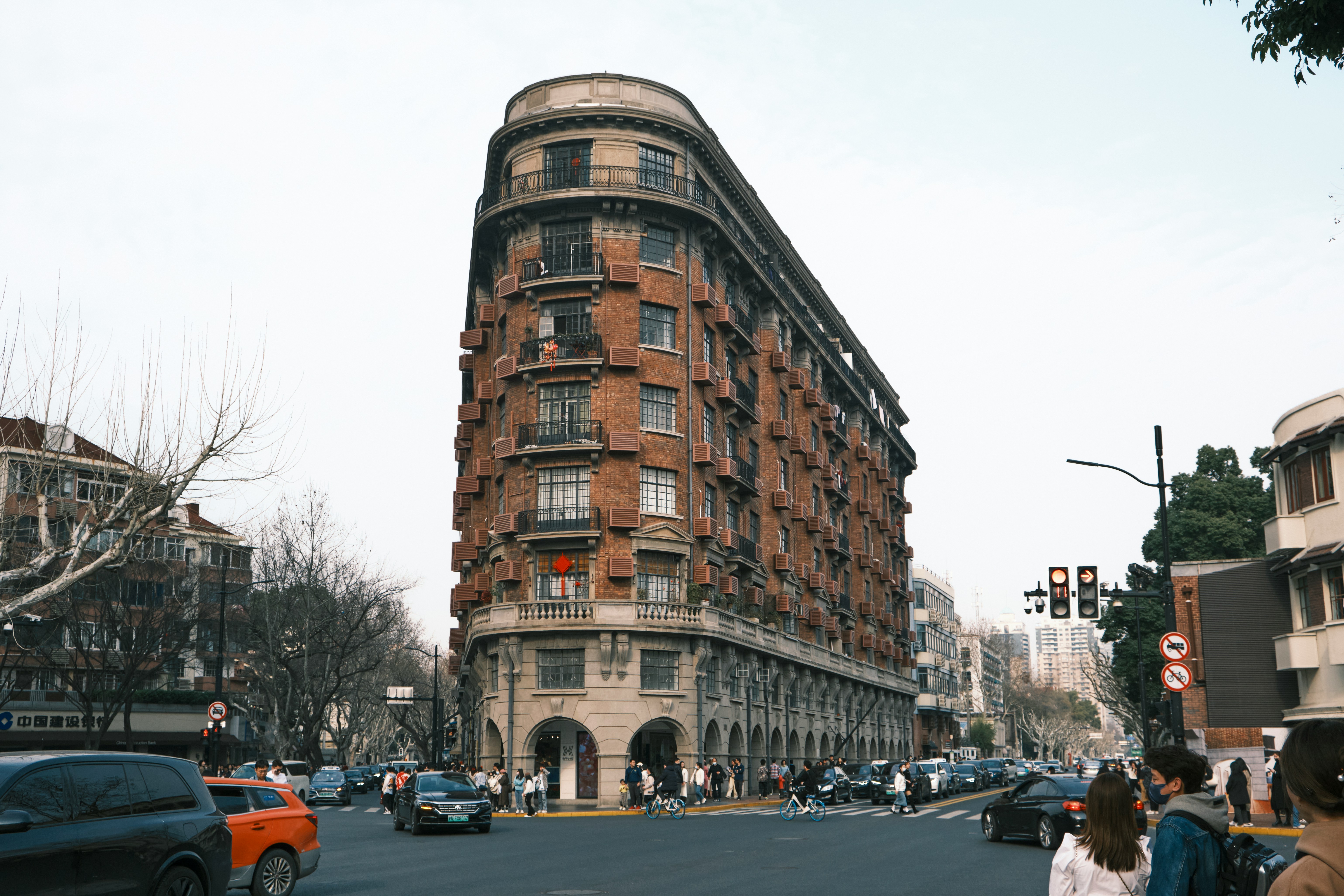
If this is your first time in Shanghai, the Bund is worth seeing. So is Lujiazui. The skyline matters. The river matters. The first look matters.
But Shanghai is not only a skyline.
Sometimes the better way into the city is to follow a person who arrived here from elsewhere, and to see how his life, his work, and the city became tied together.
That person is László Hudec.
Many first-time visitors to Shanghai have never heard his name. That is understandable. What is more interesting is that many people who live in Shanghai may not know him either. They may have passed the Wukang Mansion, walked by today's Grand Cinema, or looked up at the Park Hotel without realizing that these familiar city images are connected to the same architect.
Hudec is not just a list of buildings.
He is a way to read Shanghai.
A Man Pushed Here by History
László Hudec, often introduced in Shanghai as a Hungarian architect, was born in what was then Austria-Hungary, in today's Slovakia. Even that sentence carries the unsettled map of the twentieth century.
He studied architecture. He lived through the First World War. He was captured, escaped, crossed borders, and eventually reached Shanghai in 1918.
Shanghai was not his original destination. It was closer to a place of refuge.
A young European architect, thrown out of his earlier life by war, arrived on the edge of the Huangpu River. He did not come as a tourist. He came because history had moved him.
But later, Shanghai became his working ground.
That feels very Shanghai. Many people do not arrive here because they already understand the city. They arrive because the city gives them a place to stand. Only later do they realize that part of their life has entered its streets.
Hudec's story belongs to that pattern.
The Shanghai He Met
The Shanghai Hudec entered was changing quickly.
The city was commercially ambitious, politically complicated, and hungry for new buildings. Hotels, cinemas, apartments, hospitals, schools, and churches were all being remade. Different languages, habits, institutions, and ideas of urban life were pressed into the same streets.
Hudec was not drawing on blank paper.
He was not simply copying Europe into Shanghai. He was working inside Shanghai's conditions: tight sites, active capital, demanding clients, dense streets, mixed tastes, and a city moving faster than most people could explain.
That is why his buildings are more interesting than a style label.
A hotel had to receive people.
A cinema had to organize the night.
An apartment had to hold a new kind of city life.
A hospital or school helped the city run.
A church made room for quiet order inside a busy neighborhood.
These buildings did not only stand on a map. People entered them, lived in them, waited inside them, prayed inside them, watched films inside them, and carried ordinary days through them.
Put together, they were parts of a city learning how to live.
What Hudec Left Behind
If we only ask which buildings Hudec designed, we miss the larger point.
The Park Hotel gave Shanghai height. It was not just tall. It turned ambition, capital, and technology into a vertical image of the city.
The Grand Theatre, today's Grand Cinema, showed how entertainment could be staged by architecture. A cinema was not only a place to watch a film. It was part of urban night life, public consumption, and the modern rhythm of going out.
The Wukang Mansion, Brooklyn Court on Ruijin First Road, the Green House, Sun Ke's Villa, and other residences bring the question closer to daily life: how does a modern city house people? How does it arrange privacy, light, stairs, corners, entrances, and the street outside?
Moore Memorial Church, Xiyan Church, and other religious spaces connected to Hudec's Shanghai remind us that the city's modern life was not only commercial. It also had rooms for silence, belief, and community.
Hudec did not leave behind one single style.
He left behind samples of Shanghai life.
Why Shanghai Cannot Quite Bypass Him
Shanghai, of course, does not belong to Hudec.
Without him, Shanghai would still be Shanghai. It would still have its river, banks, factories, lanes, shops, newspapers, cinemas, migrants, workers, merchants, and ordinary daily lives.
But without Hudec, we would lose one clear way of reading the city's modern urban life.
First, he helped shape Shanghai's image of itself. The corner of the Wukang Mansion, the height of the Park Hotel, the face of today's Grand Cinema: these are not only buildings now. They are part of the city's visual memory.
Second, he turned ways of living into architecture. Look past the facade. Ask how a hotel receives guests, how a cinema organizes attention, how an apartment holds family life, how a hospital expresses order, how a church enters a neighborhood.
Third, his work speaks to Shanghai's mixed character. His buildings are not purely European, and not simply Chinese. They grew out of Shanghai's own conditions.
Fourth, many of them can still be read on foot. You can stand in front of them, look up, walk around, notice the entrance, the stair, the lobby, the way the building meets the street.
That matters.
Some city memories can only be read in books. Much of Hudec's Shanghai is still standing in the street. It does not explain itself quickly. It waits for you to slow down.
Why Follow Hudec Now
There are many city walks in Shanghai today.
Some are useful. Some are only a string of popular stops. You finish the route remembering where to take a photo, but not what the city has shown you.
Hudec's Shanghai asks for a different pace.
This is not a checklist of buildings. It is a way of reading the city through one person's path: a man who arrived in Shanghai, worked here, was changed by the city, and then left part of himself in its streets.
To follow Hudec is to see that architecture is not background. It can show how Shanghai received outsiders, organized daily life, absorbed migration, handled ambition, and made room for faith, work, entertainment, and home.
A man arrived in Shanghai.
The city held him.
Then he left his life inside the city's form.
That is where this journey begins.
One Place at a Time
We will not begin with one large complete route.
We will walk place by place.
A church. An apartment building. A cinema. A hotel. A former home. Each one is a fragment of the relationship between Hudec and Shanghai.
We will look at buildings, but also at streets.
At facades, but also at entrances.
At history, but also at how these places still breathe today.
Next time, we begin at Xiyan Church (息焉堂), also known in older sources as Sieh Yih Chapel, a quiet round-domed chapel in western Changning.
There, we will not only look at a building. We will learn how one building can become a way into Shanghai.